

Introduction: Rising Fuel Costs & Cycle Time Inefficiencies Demand a Robust Solution
Across large-scale construction, quarrying, and surface mining, project margins are squeezed by volatile diesel prices and stringent EPA Tier 4 Final / EU Stage V emission mandates. Many fleets struggle with hydraulic inefficiencies that increase cycle times by 15-20%. The large excavator class (operating weight > 45 metric tonnes) represents the cornerstone of high-mass earthmoving. Modern engineering integrates load-sensing hydraulics, reinforced undercarriages, and telemetry-driven fuel optimization to deliver a lower total cost of ownership (TCO). This analysis provides a component-level breakdown of powertrain durability, structural ISO standards, and comparative ROI data.
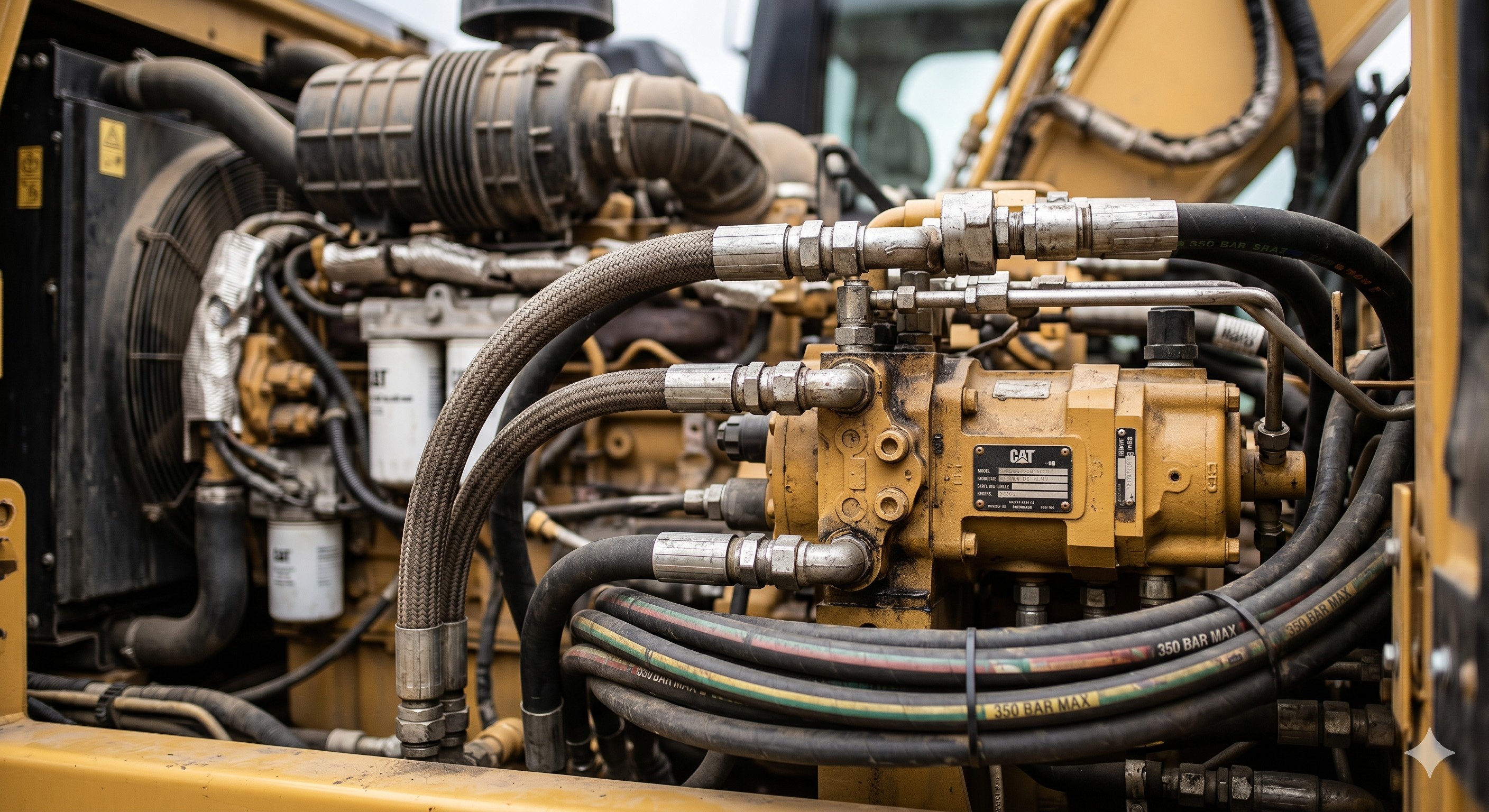
Core Powertrain & Structural Design: Engine, Hydraulics & Chassis
1. High-Pressure Common-Rail Diesel Engine
Current-generation large excavator platforms utilize turbocharged, aftercooled 6-cylinder diesels with displacement ranging 11L to 15L. Net horsepower spans 300-550 HP at 1,800-2,000 rpm. To meet EPA Tier 4 Final, engines employ cooled exhaust gas recirculation (CEGR), diesel oxidation catalyst (DOC), and selective catalytic reduction (SCR) with DEF injection. Specific fuel consumption (SFC) is typically 195-210 g/kWh under optimal load factor (0.65-0.75).
2. Load-Sensing Hydraulic System
Closed-center, load-sensing hydraulic circuits with variable-displacement axial piston pumps generate system pressures up to 34.3 MPa (4,980 psi) for attachment circuits and 31.9 MPa (4,630 psi) for travel. Independent metering valves (IMV) or intelligent hydraulic management reduces throttling losses by 10-12% compared to open-center designs. Arm crowd and bucket curl forces typically exceed 200 kN for 60-tonne class machines.
3. Chassis & UnderCarriage Durability
ISO 10265 for track-type undercarriages mandates hardened, induction-hardened links and track bushings. ROPS/FOPS cabins (ISO 3471 / ISO 3449) provide structural integrity for falling object and rollover protection. Track shoe width ranges 600-750 mm on heavy-duty models, with ground pressure maintained below 85 kPa for soft terrain mobility. Grease-lubricated, sealed track links extend bushing life beyond 4,000 operating hours.
Technical Specifications: Operating Weight, Horsepower & Hydraulic Metrics
For a representative large excavator in the 55-70 metric tonne class (e.g., Komatsu PC7000-11 class or Caterpillar 374F), the following parameters define performance and compliance.
[TABLE_1]Comparative Advantage: TCO, Fuel Efficiency & ROI Analysis
When evaluating a large excavator against wheel loaders or rope shovels for bulk excavation, the key differentiator is cost per bank cubic meter (bcm) moved. A modern large excavator equipped with high-efficiency hydraulics and auto-idle/shutdown achieves 12-15% lower fuel consumption per bcm compared to Tier 3 models. Lifecycle TCO analysis over 12,000 operating hours:
Initial capital: $650k–$950k (new) vs $400k–$550k (remanufactured).
Fuel cost (12k hrs @ 32 L/hr, $0.85/L): $326,400.
Maintenance & wear parts (teeth, filters, hydraulic oil, tracks): $0.18-$0.22 per hour = $2,400-$2,640 annualized.
Residual value after 5 years: 35-40% of new price. ROI positive by year 3 for high-utilization (2,500 hr/year) mining contracts due to cycle time reduction (up to 18% faster truck loading).
Heavy-Duty Application Scenarios
- Surface Mining & Overburden Removal: Paired with rigid dump trucks (100-150t capacity), large excavator cycle times of 22-28 seconds achieve 500-600 bcm per hour.
- Large-Scale Earthmoving for Dams & Highways: Mass excavation with bucket capacities 3.5–5.0 m³, cutting vertical banks up to 12m height.
- Manufacturing & Scrap Handling: With orange-peel grapples or magnets, large excavators process ferrous scrap at rates > 150 tonnes per hour.
- Underground hard rock (limited): Reduced-height versions with reinforced booms and ISO 2380-1 flame-retardant hydraulics.
Conclusion: Productivity as a Function of System Integration
The modern large excavator is no longer just a digging tool — it is a data-rich, emissions-compliant, and TCO-optimized asset. Fleet owners who prioritize load-sensing hydraulics, telematics for real-time fuel monitoring, and predictive undercarriage maintenance reduce unscheduled downtime by up to 30%. As electromobility enters the >45-tonne segment, early hybrid and cable-electric models suggest a future with lower noise and near-zero emissions, but today’s diesel Tier 4 platforms remain the industrial productivity benchmark. For engineering-driven procurement, always request hydraulic system response curves and SFC maps from OEMs.